To receive e-news about future workshops - Sign-up for email newsletters regarding workshops!
For additional information, to schedule a workshop or presentation for your group - Contact Marion
|
| calendar |
No workshop or classes are currently scheduled - Contact Marion if you are interested in scheduling a class.
|
workshops - program descriptions |
Cavandoli Cabochon Setting with Leaves & Flowers | Cavandoli 2.0
Crown Knotting | Bead Edging around the Donut
Cord, Nothing but Cords | Turk's Head Knots | Braided Kumihimo Neckpiece
How to End Kumihimo Braids and Make Clasps | Chinese Button Knot Amulet |
| 2 day program |
Cavandoli Cabochon Setting with Leaves & Flowers, a 'Micro-Macrame Master's Workshop'
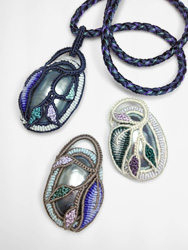
On the first day, learn how to set a cabochon in a micro macrame setting with nylon & silk thread. The second day, learn how to knot leaves, stems and flowers. This workshop teaches a method to set cabochons without the use of any glue, by caging the cabochon with bonded nylon and silk thread and double half hitches and a wire armature. It will also introduce free-form Cavandoli knotting techniques. The finished piece will be a brooch or a medallion. This class is the foundation for setting cabochon and knotting free open forms in a Cavandoli style. Once the technique is aquired, it can expanded to larger pieces.
Knowledge of double half hitch is a prerequisite. Several tutorial are available to download. Bring sampler to class. Download tutorial #1 (pdf) or view as an html page or tutorial #2 (pdf)
Please note that the braided cord for the medallion is not taught in this class. |
|
|
|
|
2 day program |
Cavandoli 2.0
|
|
|
Cavandoli is a specialized knotting technique in which double half hitches are knotted in a continuous fashion, with no loose thread or spaces between the knots, creating a woven-like tapestry. Traditionally two colors are used and patterns are created by alternating horizontal and vertical double half hitches. Refer to a blog entry done on Cavandoli and who was Valentina Cavandoli for more info on this technique and its history.
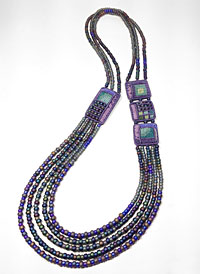
Cavandoli 2.0 will take you beyond the two color limitation. A series of techniques will provide you with the tools for color control and to be able to bring a color exactly where you want it. With the use of wire armatures, vertical, horizontal and reverse double half hitches, we will create module like textile pieces. Texture and relief will be explored. The pieces we will create will be planned and structured. These modules will become the focus pieces for a beaded opera length infinity neckpiece with no clasp, or a cartouche medallion.
Class projects are made with C-Lon Bead Cord and various seed beads and are available in several color schemes, so you will be able to choose your own color variations. Keep in mind that Cavandoli is a slow process with lots of knots per square inch, so the projects will most likely not be finished in class. Practicing of the double half hitches before class is required! > double half hitch tutorial #1 (pdf) or view as an html page or tutorial #2 (pdf). It will make all the difference! |
| |
|
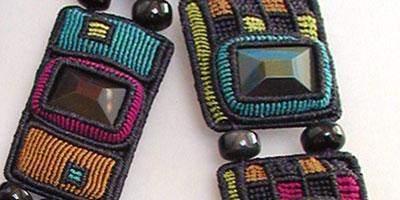
Example of Cavandoli knotting with gemstone set in double half hitches made with nylon and silk thread
|
| 1 day program |
| Crown Knotting & Fiber Endings |

|
Crown knotting or the crown knot sennit is an elegant solution for stringing beads with larger holes such as antique beads and keeping them from touching each other. The crown knots have many advantages over traditional overhand knots. The knots are completely symmetrical. They are easier to keep snug against the beads and are especially well suited when stringing beads with large holes or uneven holes as the ratio between the cord going through the beads and the actual size of the knot is much larger than with overhand knots.
Learn how to tie 4-strand crown knots with the use of a kumihimo disk, a method that makes this process much easier to learn and master. Plus learn how to integrate a clasp with a button and loop seamlessly with no loose thread or thread ends remaining.
|
|
Topics to be covered:
The crown knot sennit with and without the use of a kumihimo disk
How to start the sennit
Making the button
The loop
Ending without any loose thread
Best materials to use.
Please note: A bracelet will be made during class. Larger projects such as neckpieces can be made after the class.
|
 |
|
| 1 day program |
| Bead Edging around the Donut |
Create your own amulet, brooch or earrings with a silk fan and bead edging around a gemstone donut or pie.
We will explore several methods with the use of charts and hands-on demonstration.
This class is appropriate for various levels of experience.
No prior experience is necessary! |
Topics to be covered:
1. Design
2. Bead edging around the donut/pie
3. Beaded tassel
4. Methods for attaching various elements
5. Square knot braid loop
6. Cordmaking, 2 and 3 ply
7. Finishing ends and glue primer
|
 |
|
| 1 day program |
| Cords & Braids |
We will explore several methods to create cording: rope making and braiding with a limited use of tools.
With charts and hands-on demonstration we will make various types of cording and discuss their possible uses. This class is appropriate for various levels of experience.
No prior experience is necessary! |
Topics to be covered:
1. cords 2 ply
2. cords 3 ply
3. Kumihimo, Peruvian Braids -Maru Dai and Disk-Free
4. Finishing the Cords and Adhesive Primer
5. Material & Use
6. Various methods for attaching elements, suggestions & ideas
|
 |
|
| 1/2 day program |
|
|
The Turk's Head is a beautiful ornamental knot made with one thread/cord only, similar to a braid. It is used extensively in Chinese Knotting, Japanese and Celtic designs and for tassels. Historically on ships it was used on hand railing, around stanchions or on a hammer handle to secure a firmer grip.
It is made around a larger object such as a larger cord or tube, to add a contrasting color or to join several cords. It can also be used as a covering.
The golden Turk's Head shown here is joining the two kumihimo braids together.
This particular one is a Five-Strand Turk's Head with 5 passes.
This class includes:
A color chart with 7 illustrations
An actual sample showing the main 5 steps of this knot
No experience necessary!
|
| 1 day program |
Braided Kumihimo Neckpiece
Create a neckpiece using a simplified kumihimo braid that can be made without the use of a maru dai, saving yourself the hassle and the expense of purchasing it. Sterling silver clasps for finishing the cording will be available for purchase.
This class is appropriate for various levels of experience.
No prior experience is necessary!
|
|
Topics to be covered:
1. Kumihimo braid (Peruvian braids), Spiral braid
2. Square knot braid loop
3. Anchoring beads tassel
4. Finishing the ends and glue primer
5. Material & Use
6. Various method for attaching elements, suggestions & ideas
|
| 1 day program |
How to End Kumihimo Braids and Make Clasps! |

Kumihimo cords present a unique challenge to finish.
What to do with all the ends of cords/thread...
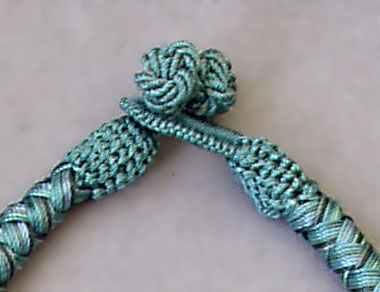
How to integrate a clasp if no metal tubular findings are desired... Learn how to secure the threads at the end of the braid by wrapping and covering them and create a fiber based clasp.
Several ways of making clasps with fiber techniques will be explored in this class:
• Knotted loops with several versions
• Buttons: Knotted Chinese button, gemstones donuts, beads, toggles and loops
• Coverings
|
 |
 |
Students will apply one technique learned in class based on knowledge and experience with knots, such as the Chinese Button Knot and Turk's Head.
Written and illustrated directions for all the techniques shown in the class are included in the manual.
Kumihimo will not be taught in this class. Bring your kumihimo cords to finish or you will be provided with a braid to finish at the class. This class is a technique only class. No actual finished piece will be made. |

|
| 1 day program |
A Chinese Diamond Knot Amulet with Bead Edging
Create your own amulet around a gemstone donut or pie.
Explore several techniques with the use of charts and hands-on demonstrations.
We will make a 3 ply cord, learn how to wrap the donut with lark heads knots and master the beautiful Chinese button knot.
This knot or rather perfectly symmetrical braid is used extensively in Chinese designs.
It makes a fabulous button as well.
This class is appropriate for various levels of experience.
No prior experience is necessary!
|
Topics to be covered:
1. Design
2. Cordmaking
3. The Chinese Button Knot
4. Lark Heads around Donut
5. Alternating Half Hitch Braid
6. Finishing Techniques
|
|
|